
Most downspout runs cost $150 to $400 each, including elbows, straps and an extension or splash block. Underground drain lines to a pop-up emitter typically run $600 to $1,200 depending on length, roots and where the water can go.
Downspouts & drainage · Gainesville & Alachua County, FL
Downspouts & Drainage in Gainesville, FL
Bigger downspouts where the roof needs them, extensions and splash blocks that actually reach past the beds, and underground drain lines that carry roof water away from the slab. Planned around Gainesville's sandy soil and heavy summer rain.
- Downspouts
- $150 – $400 per run
- Underground drains
- $600 – $1,200
- Sizes
- 2x3 and 3x4 aluminum
- Goal
- Water off the slab
Downspouts & Drainage in Gainesville, FL That Finish the Job
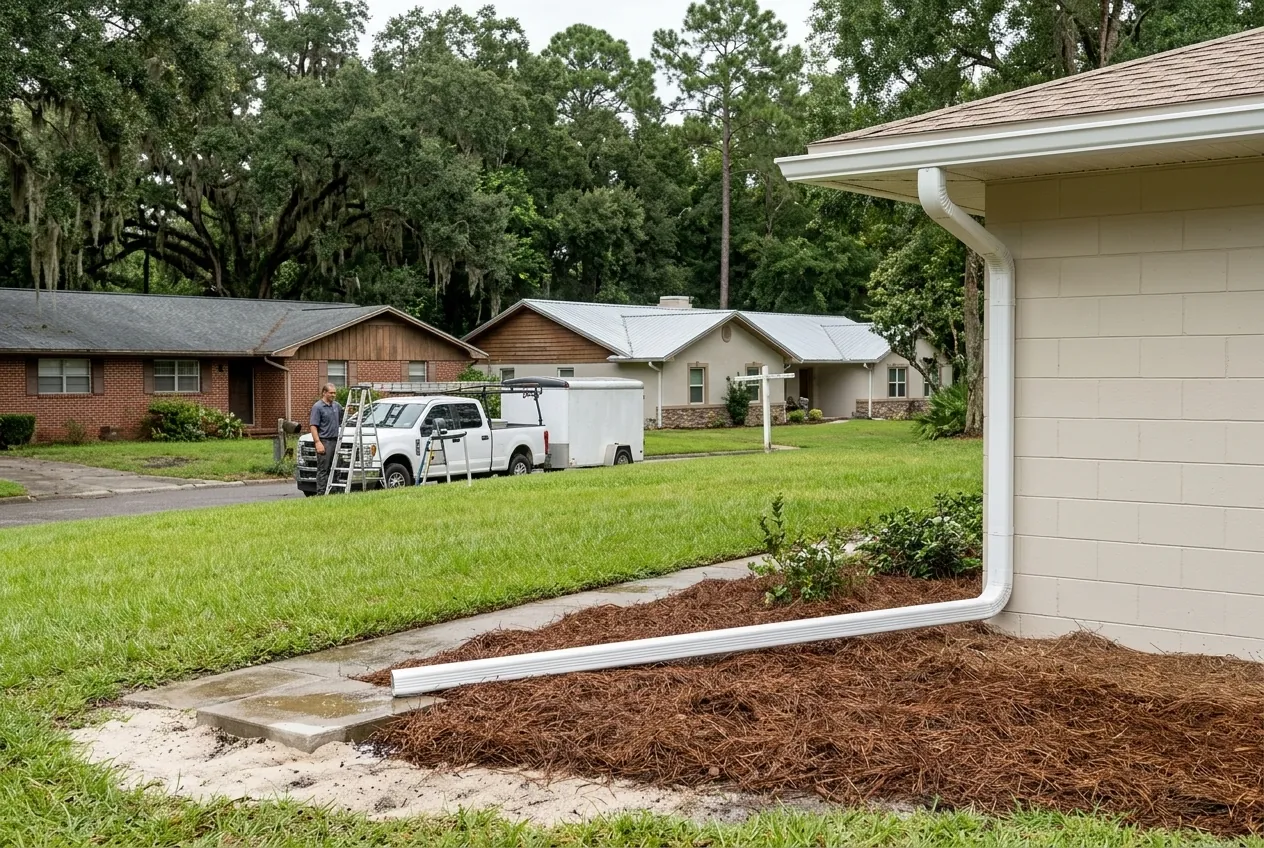
A gutter only collects water. The downspout and whatever sits at the bottom of it decide where that water ends up. On a lot of Gainesville homes, the gutters are fine and the problem is the last six feet: a small downspout that cannot keep up, an elbow dumping into a flower bed, a splash block that slid away years ago, or an extension that points straight at a neighbor's yard. The result is the same every time. Water collects against the slab, washes out mulch and sand, and finds its way into garages and lanais.
Our drainage work starts in the rain if possible, or with a hose if not. We watch where each downspout discharges, where water pools and which way the ground slopes. Then we size and place downspouts for the roof area they serve and pick the simplest way to move the water away: an extension, a splash block, a pop-up emitter at the end of a buried line, or a connection to an existing drain where one is allowed.
Common fixes
- Upsizing 2x3 downspouts to 3x4 on large roof planes
- Adding a second outlet to long gutter runs so one downspout is not doing all the work
- Extensions and splash blocks that discharge several feet out from the foundation
- Underground solid pipe to a pop-up emitter in the lawn or a spot where the yard falls away
- Re-routing downspouts that dump onto walks, driveways, A/C pads or pool decks
- Straps and brackets on loose downspouts that rattle or pull off in storms
Gainesville Downspout Sizing: 2x3 vs 3x4
A useful rule of thumb is one square inch of downspout opening for every 100 square feet of roof that drains to it. A standard 2x3 rectangular downspout has about 6 square inches of opening, so it is good for roughly 600 square feet of roof. A 3x4 has 12 square inches, good for about 1,200. Roof pitch raises the effective area, since steep roofs catch more wind-driven rain. Published guidelines add 5 to 30 percent to the roof area depending on slope.
Put those numbers next to a typical house and the problem is easy to see. A ranch with a 900-square-foot rear roof plane and one 2x3 downspout at the corner is already past what that downspout is rated to carry. During one of Gainesville's afternoon thunderstorms, when NOAA's Atlas 14 tables show short bursts falling at several inches per hour, the downspout backs up, the gutter fills and water pours over the front edge. Swapping to a 3x4, or adding a second outlet midway down the run, usually fixes it for a few hundred dollars. Our guide to gutter sizes for Florida rain works through more examples.
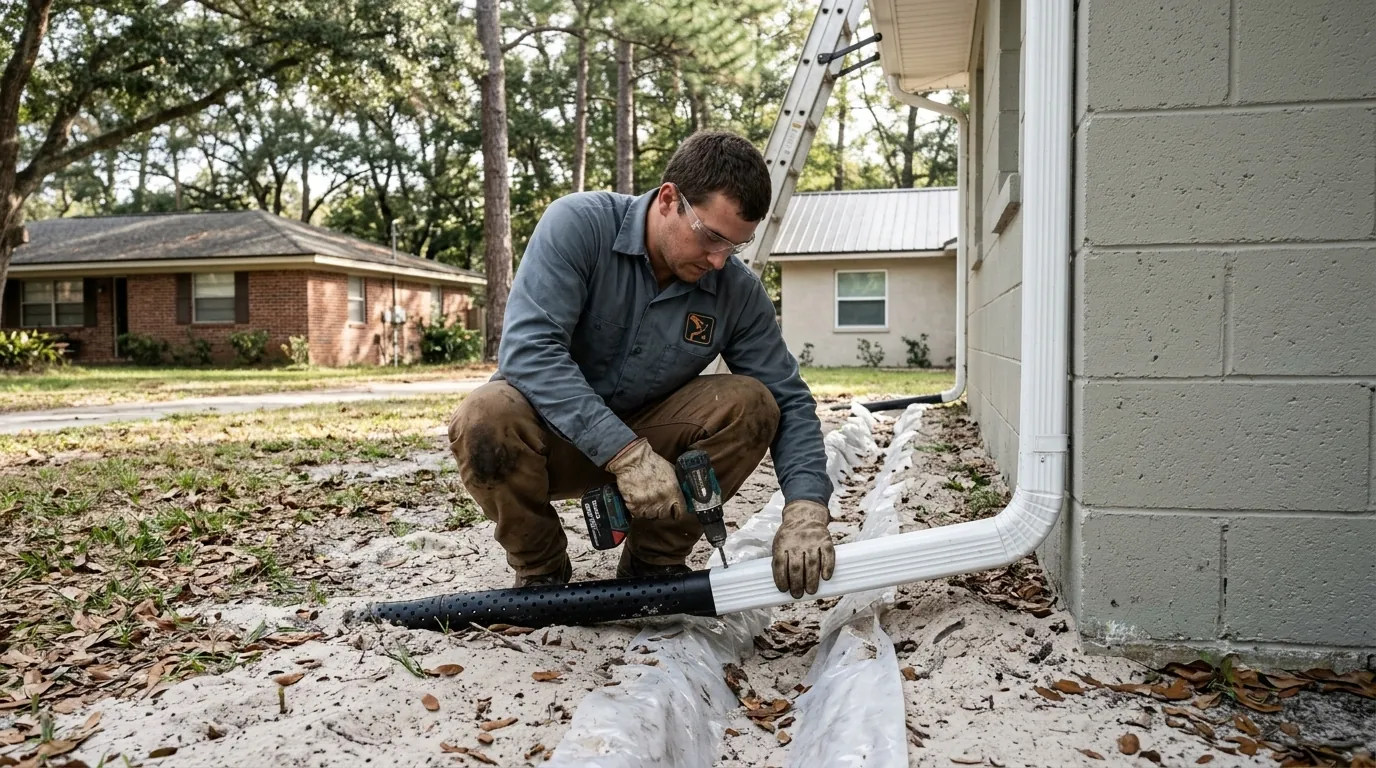
Downspout outlets are also where clogs start. Sweetgum balls, acorns and wads of oak catkins collect at the opening. A 3x4 outlet clogs far less often than a 2x3 under the same trees, which is another reason we lean toward the larger size under heavy canopy.
Downspout and Drain Line Prices in Gainesville
Most downspout work in Gainesville runs $150 to $400 per run, including elbows, straps and an extension or splash block. Underground drain lines run $600 to $1,200 each, depending on length, depth, roots and where the line can discharge. Every run is listed on the written quote with its size and where it will drain.
| Job | Typical range | What moves the price |
|---|---|---|
| New or upsized downspout run | $150 – $400 each | Height, 2x3 vs 3x4, elbows around obstacles |
| Extension and splash block | $150 – $400 each | Length, buried or surface, bed edging |
| Underground drain line to emitter | $600 – $1,200 | Pipe length, roots, slope to the outlet |
| Second outlet added to long run | $150 – $400 each | Gutter condition where the hole is cut |
| Downspout clog cleared or reattached | $125 – $600 | Packed elbows, buried line flush, bracket repair |
| Larger gutters to match new downspouts | $9 – $14 per ft | Whether existing 5" runs can stay |
If the gutters themselves are undersized or leaking, fixing the bottom end alone will not stop overflow. In that case the quote will show the cost of new seamless gutters next to the drainage work so you can decide what to do first.
Splash Blocks, Underground Drains and Gainesville's Sandy Soil
Much of the Gainesville area sits on deep, well-drained sands. USDA soil descriptions for local series like Millhopper and Arredondo describe sand running many feet deep with rapid permeability. Sand soaks water up quickly, but it also moves easily. A downspout dumping straight onto bare sand cuts a hole, then a channel, and over a few summers it carries sand away from the edge of the slab and out of the beds. Mulch floats off and ends up on the driveway.
For that reason, simple fixes work well here when they are done right. A splash block sitting flat on firm ground, with its lip angled away from the house, spreads the flow so it soaks in instead of trenching. An extension carries water a few feet farther out, past the beds and into the lawn. For downspouts next to walks, patios or driveways, an underground drain line is the cleaner answer. Solid pipe runs from the downspout to a pop-up emitter in the lawn or to a point where the yard falls away, and water spreads out and soaks into the sand there.
What the building code says about roof water
The Florida Residential Code does not require gutters on most homes. It does require lots to be graded so the ground falls at least 6 inches within the first 10 feet away from the foundation, and where expansive or collapsible soils are known to exist, it requires a controlled method of collecting roof water and discharging it at least 5 feet from the foundation or into an approved drainage system. Even where that rule does not formally apply, 5 feet is a good target for every downspout we set.
Karst and where not to send water
Alachua County's own sinkhole guidance notes that sinkholes form mostly in the western and central parts of the county, where limestone lies close under permeable sand. We do not concentrate roof water into one spot next to a house, and we do not tie downspouts into dry wells or other buried features without a reason and the owner's okay. Water spread over a lawn is the safest destination on most lots. If you have seen a depression forming in the yard, tell us at the estimate so the drain line can be routed away from it.
Gutter Drainage Fixes Around Gainesville
Older homes with low, flat lots, like many of the mid-century houses in Kirkwood, often have downspouts pointed at walks or driveways because there was nowhere else to send the water. Newer homes on sloped lots in Haile Plantation and out toward Newberry can have downspouts discharging toward a neighbor's side yard or into a drainage swale that needs to stay clear. Both get the same approach: figure out where the water can go, then set the shortest, simplest path to get it there.
If clogged downspouts are the real issue, a regular gutter cleaning that includes flushing every outlet may be all you need. If water is running behind the gutter and down the fascia instead of down the downspout, the board may already be soft, and our fascia and soffit repair page explains what happens next.
Downspout and drainage work is available all over Gainesville, FL and Alachua County. Phone or text, or snap a picture of where the water ends up and attach it to the estimate form, and we will walk the lot with you.
Downspouts & Drainage Gainesville FL Questions
Straight answers before you call.
Often, yes. A 2x3 downspout is good for roughly 600 square feet of roof and a 3x4 for about 1,200. Many Gainesville ranches have one 2x3 handling a large back roof plane, which is why gutters overflow during summer storms. A 3x4 also clogs less often under oaks and sweetgums.
Aim for at least 5 feet from the foundation, which is the distance the Florida Residential Code uses where controlled roof drainage is required. Farther is better if the yard allows it. The ground near the house should also slope away, falling at least 6 inches in the first 10 feet.
They are worth it where a downspout has to cross a walk, patio or driveway, or where surface water would run toward a neighbor. In open lawn, a well-placed extension and splash block is often enough, because Gainesville's sand soaks water up quickly once it is spread out.
They can, mostly when gutters overflow debris into the downspout. A cleanout fitting near the downspout makes flushing easy, and keeping the gutters clean or guarded protects the line. We flush buried lines as part of a cleaning visit when asked.
Only where the local rules and the drain owner allow it, which is not common for single homes. Most lots in Gainesville are better served by spreading roof water over the lawn, where it soaks into the sand. We will tell you what is realistic at the estimate.
Get Roof Water Away From Your Slab
Downspouts sized for the roof and discharge points that work in sand, with a written price for every run.