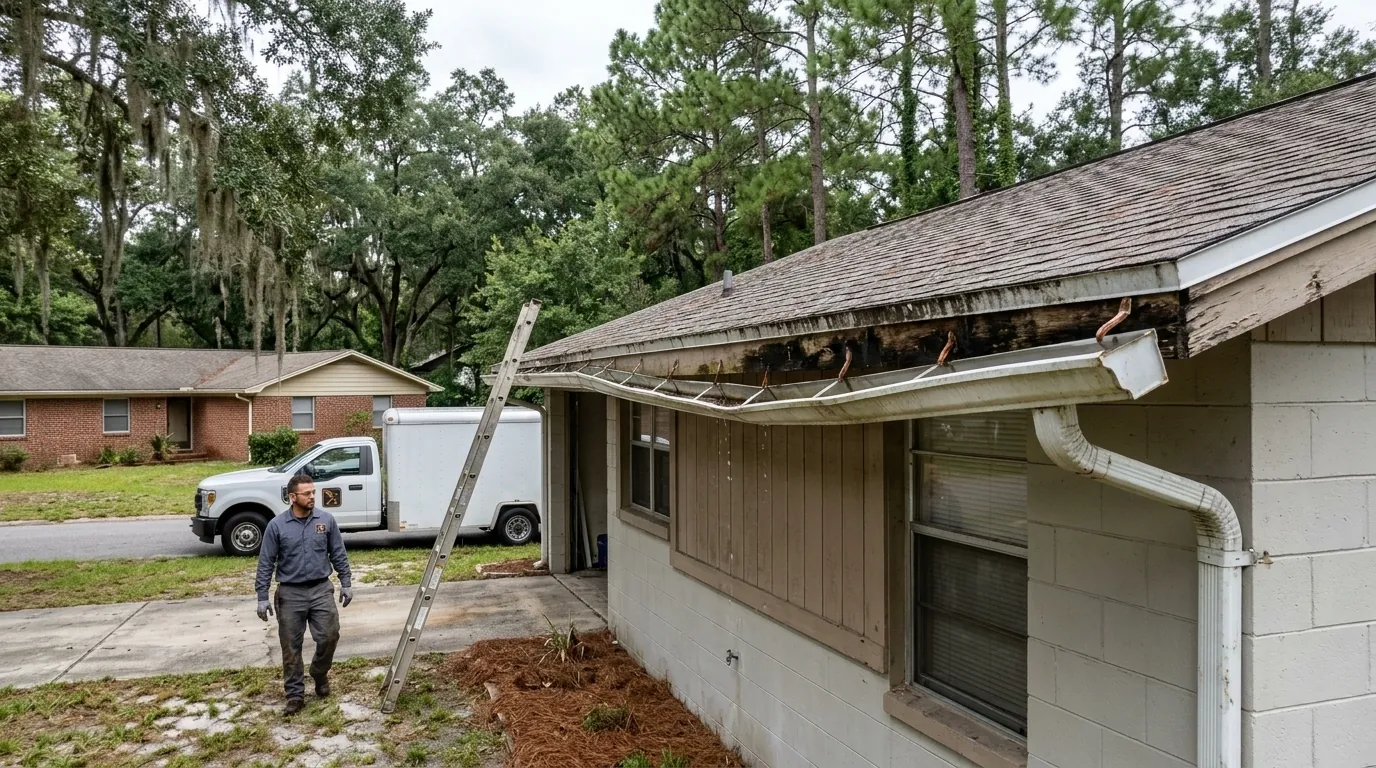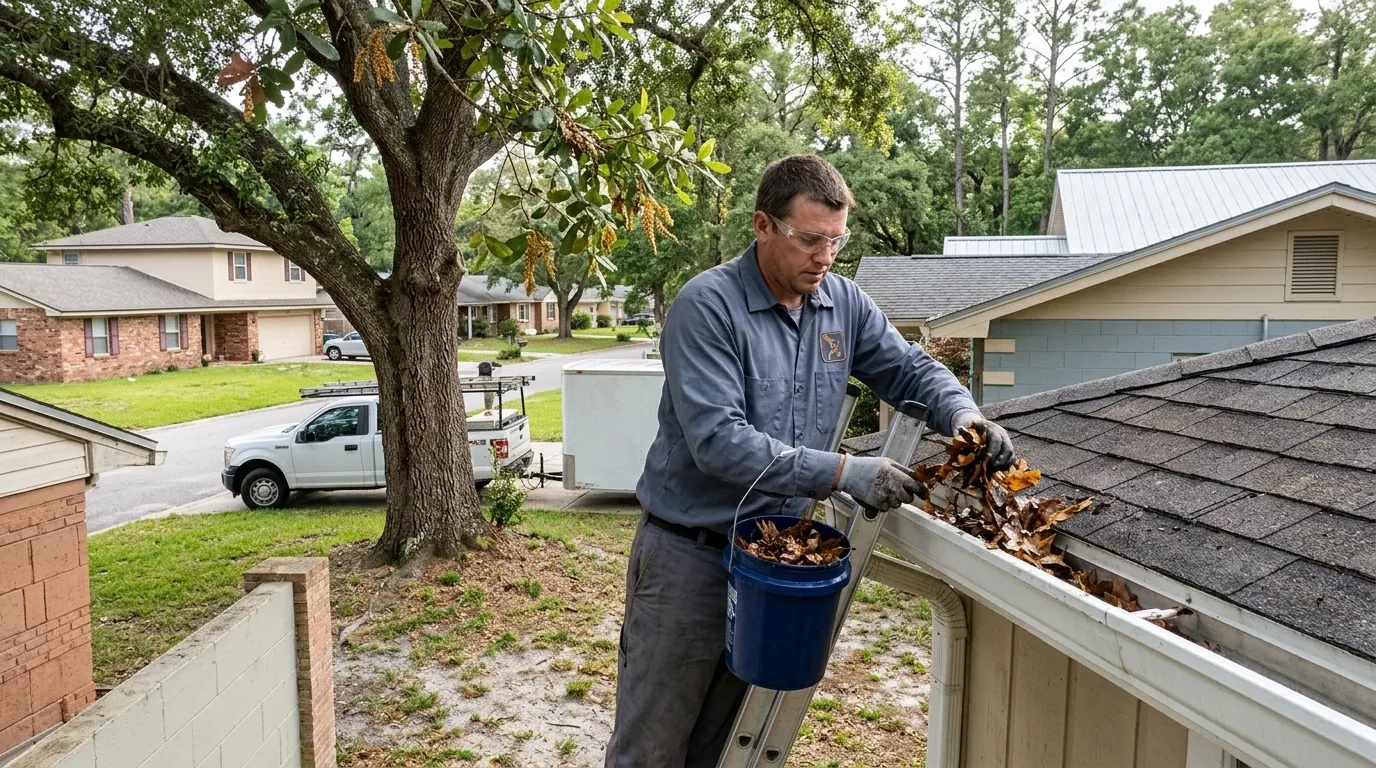
Most gutters in the country are 5-inch K-style because that is what the supply house stocks and what crews are used to hanging. Sometimes that is the right call here. Often it is not. The honest answer to "what size do I need" depends on three numbers: how much roof drains into each run, how steep that roof is, and how hard it rains at the peak of a storm. Here is how each one works for gutters in Gainesville, FL.
Gainesville Rainfall: Total Inches vs. Peak Intensity
NOAA's 1991 to 2020 climate normals for Gainesville Regional Airport put average annual rainfall at 48.31 inches. More than half of it falls from June through September: June averages 7.56 inches, July 6.68, August 6.40 and September 5.05, for about 25.7 inches in four months. The same normals show an average of about 14 days each year when an inch or more of rain falls.
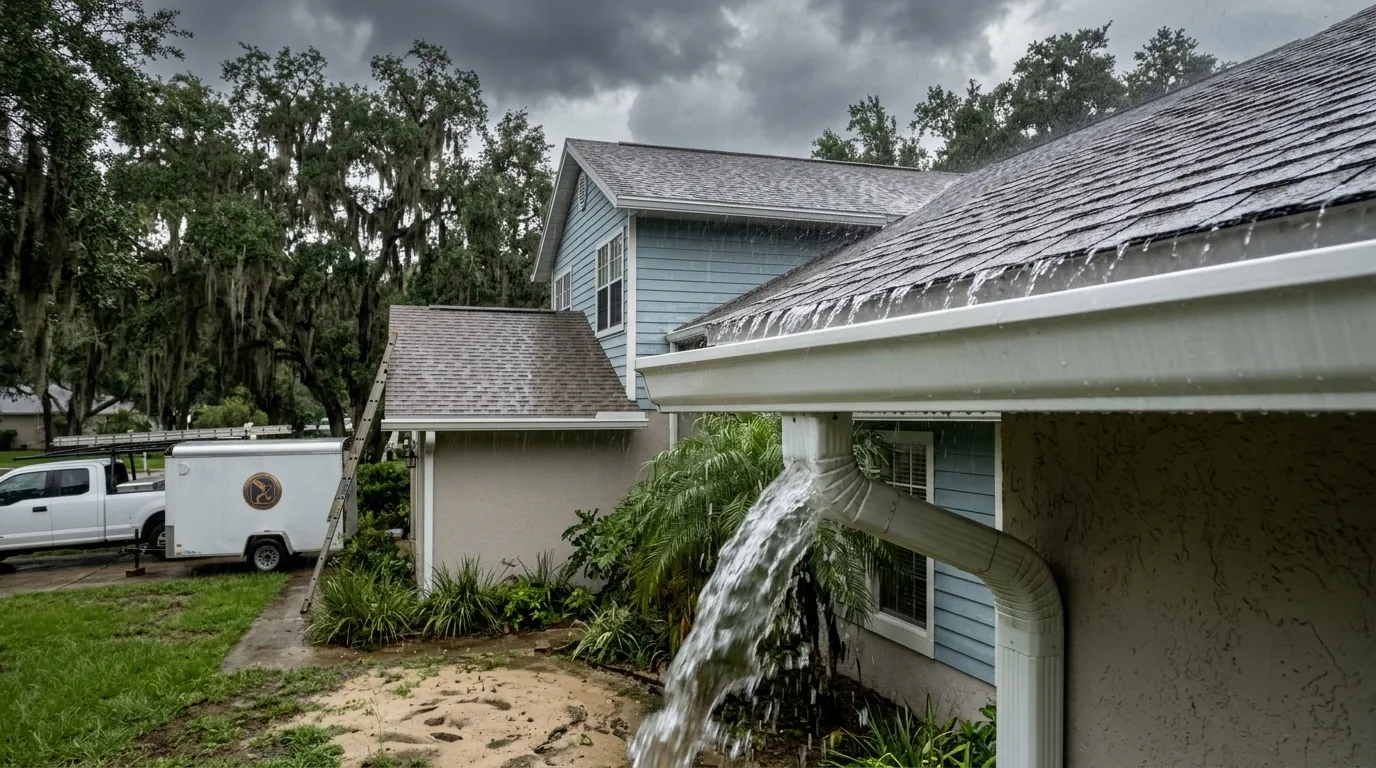
Annual totals are useful for planning cleanings, but gutters do not fail because of a wet year. They fail in the worst few minutes of a storm, when water comes off the roof faster than the trough can carry it to a downspout. That is why gutter sizing uses rainfall intensity, measured in inches per hour over a short window.
NOAA rainfall intensity for Gainesville
NOAA Atlas 14, through the National Weather Service's Precipitation Frequency Data Server, gives these intensities for a point in central Gainesville. A "10-year" storm is one with about a 10 percent chance of happening in any given year, not one that waits a decade.
| Storm duration | 2-year | 10-year | 25-year | 100-year |
|---|---|---|---|---|
| 5 minutes | 6.88 in/hr | 9.22 in/hr | 10.6 in/hr | 12.8 in/hr |
| 15 minutes | 4.09 in/hr | 5.48 in/hr | 6.34 in/hr | 7.62 in/hr |
| 60 minutes | 2.06 in/hr | 2.82 in/hr | 3.31 in/hr | 4.08 in/hr |
Look at the top row. A 10-year, 5-minute burst in Gainesville runs about 9.2 inches per hour, which is about three quarters of an inch landing on your roof in five minutes. The common sizing method from the sheet metal trade, described in detail by Fine Homebuilding, uses exactly that number: the 10-year, 5-minute intensity.
How Gutter Sizing for Florida Rain Actually Works
The method is the same one used for commercial work, simplified for houses.
- Find the roof area that drains to one gutter run. Use the horizontal plan area: the length of the eave times the horizontal depth from eave to ridge (or to wherever that roof face ends).
- Adjust for pitch. Steeper roofs catch more wind-driven rain. Multiply by a pitch factor: 1.00 for flat to 3-in-12, 1.05 for 4 to 5-in-12, 1.10 for 6 to 8-in-12, 1.20 for 9 to 11-in-12 and 1.30 for 12-in-12 and steeper.
- Look up gutter capacity. Published figures for a level gutter at 1 inch per hour are about 5,520 square feet for 5-inch K-style and about 7,960 square feet for 6-inch K-style.
- Divide by your local intensity. That gives the largest adjusted roof area one gutter section can serve between a high point and a downspout.
Run Gainesville's 9.22 inches per hour through step four and you get these limits for a level gutter:
| Gutter | Capacity at 1 in/hr | Max adjusted area per section in Gainesville |
|---|---|---|
| 5" K-style | about 5,520 sq ft | about 600 sq ft |
| 6" K-style | about 7,960 sq ft | about 860 sq ft |
"Per section" matters. A run with a downspout at each end, or one in the middle, splits the roof into two sections, and each one only has to handle its own half. Adding a downspout is often the cheapest way to fix an undersized gutter.
What about sloping the gutter?
Fine Homebuilding notes that pitching a gutter 1/8 inch per foot lets it carry roughly 1.4 times as much water. That is a steep slope, five inches over a 40-foot run, and it shows from the street. Most residential gutters are hung with a gentler fall that keeps water moving but looks level, so we size as if the gutter were close to level and treat any extra slope as a safety margin.
A Worked Example: Sizing Gutters for a Gainesville Two-Story
Take the back of a two-story house with a 48-foot eave. The roof face runs 18 feet horizontally from the eave to the ridge, and the pitch is 7-in-12.
- Plan area: 48 x 18 = 864 square feet.
- Pitch factor for 7-in-12: 1.10, so adjusted area is about 950 square feet.
- One downspout at one end: 5-inch handles about 600 square feet, too small. 6-inch handles about 860, still short.
- Downspouts at both ends: each section serves about 475 square feet. Either size works, and 6-inch has real headroom.
On this house we would usually recommend 6-inch gutters with two downspouts. The 5-inch option with two outlets technically passes, but it leaves almost no margin for a few oak leaves sitting in the trough, which is the normal state of a Gainesville gutter between cleanings.
Downspout Size and Spacing for Florida Gutters
A gutter is only as good as its outlets. The rule of thumb printed in Fine Homebuilding and This Old House is that each square inch of downspout cross section drains about 100 square feet of roof. By that rule a standard 2x3-inch downspout serves about 600 square feet and a 3x4-inch serves about 1,200. Those are general figures not tuned to our rain rates, so we treat them as ceilings, not targets.
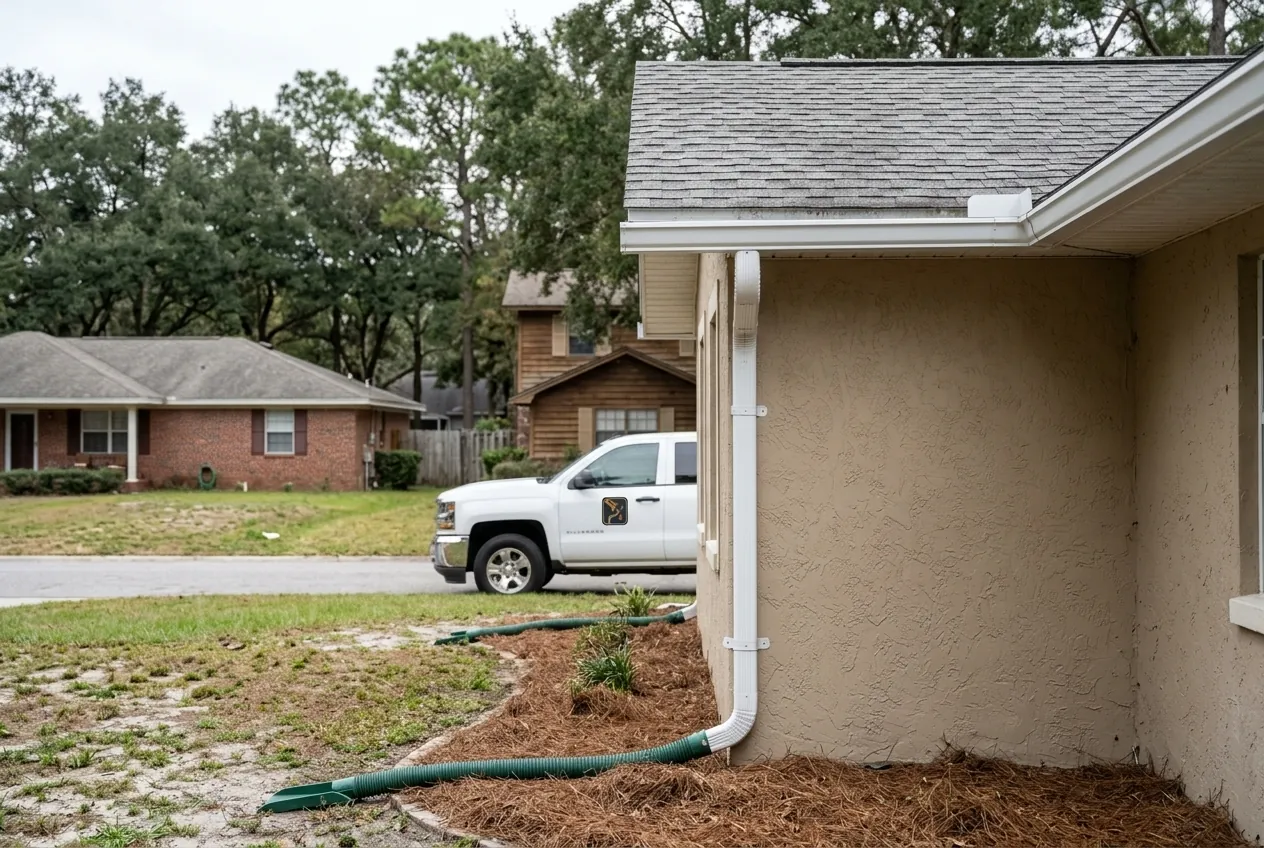
- Use 3x4-inch downspouts on 6-inch gutters and on any 5-inch run collecting from a big roof face. The bigger opening also passes oak leaves and acorns that jam a 2x3.
- Plan at least two outlets on any run of 60 feet or more, a guideline This Old House attributes to its builders.
- Put a downspout near the bottom of any roof valley, where two roof faces pour into one spot.
- Keep outlets where the water can go somewhere useful, not into a walkway or the pool deck.
Our downspouts and drainage service covers upsizing outlets, adding runs and burying lines to carry water away from the house.
Gutter Size Choices for Common Gainesville Rooflines
These are general patterns, not a substitute for measuring your roof.
| Roof situation | Typical recommendation | Why |
|---|---|---|
| Low-slope ranch, short runs, several downspouts | 5" with 2x3 or 3x4 outlets | Small sections, modest pitch |
| Ranch with a long back eave or big hip faces | 5" with extra outlet, or 6" | Large sections overflow first |
| Two-story, steep pitch | 6" with 3x4 outlets | Pitch factor and height add up |
| Valley dumping onto a short gutter | 6" at that spot plus a valley guard | Concentrated flow overshoots the lip |
| Heavy oak or pine canopy overhead | Size up and use 3x4 outlets | Debris eats capacity between cleanings |
Single-story homes in Millhopper and Tioga both show up in that list. Wooded lots under tall oaks and pines push toward bigger outlets, and newer, larger houses with long rear eaves push toward 6-inch gutters.
Where the Water Goes After the Gutter
Sizing does not stop at the downspout. Gainesville sits on sandy soils over limestone, and a downspout that empties against the foundation can wash out sand from under a walkway or slab edge and leave planting beds rutted. A downspout extension that carries water several feet out, or a buried drain line to a spot where the yard slopes away, finishes the job the gutter started. Underground lines run $600 to $1,200 in most yards.
If you are replacing gutters anyway, this is the moment to get the size right. Our seamless gutter installation estimates include measuring each roof face and recommending the gutter and outlet sizes in writing. You can request a free estimate and we will show you the math for your house.