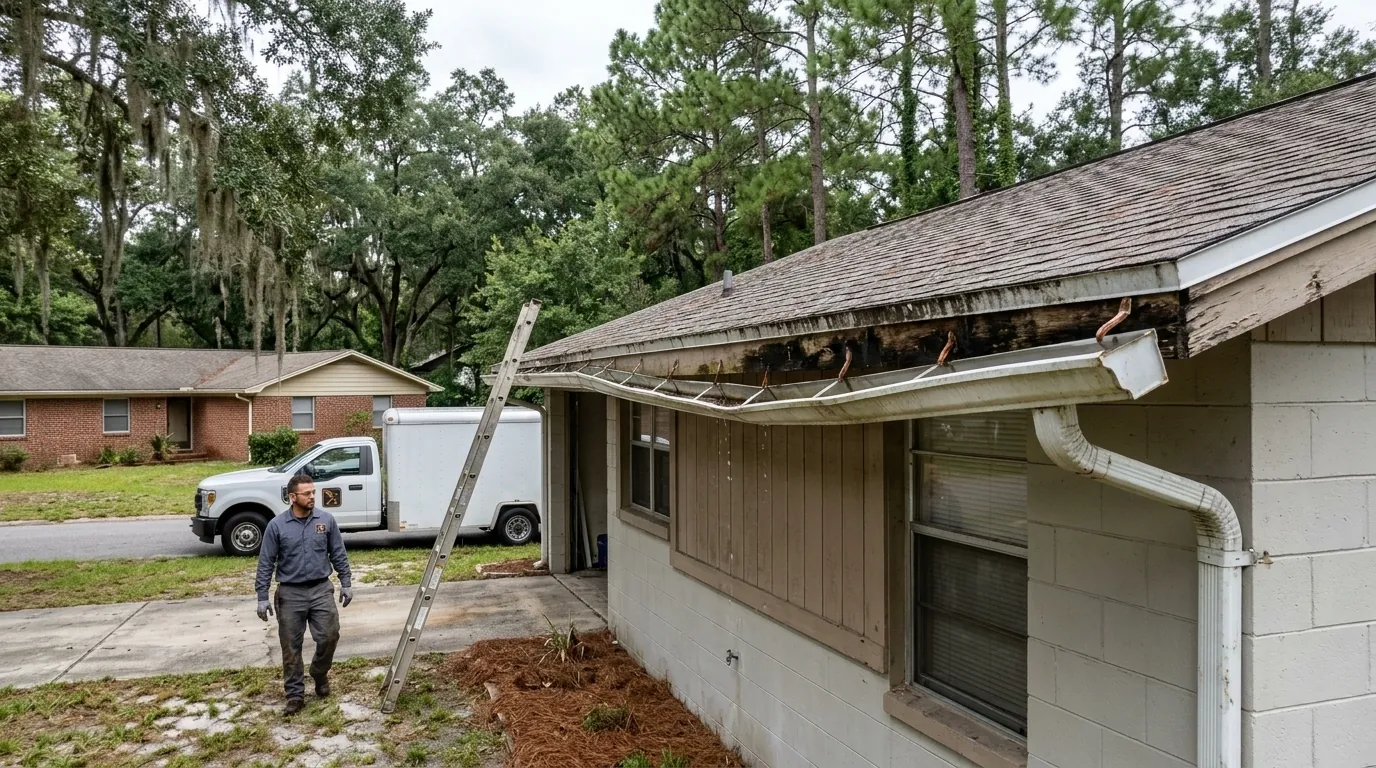
If you walk a block in an older Gainesville neighborhood after a summer storm, you can usually spot the sectional gutters. They drip at regular intervals, right where two pieces meet. Seamless gutters are not magic, but removing those joints solves the most common gutter complaint we see. Here is a fair comparison for gutters in Gainesville, FL, including the cases where sectional is still the sensible choice.
Seamless vs. Sectional Gutters: How Each Is Made
Sectional gutters come in fixed lengths from a store, commonly 10 feet, in aluminum, vinyl or galvanized steel. They are joined with slip connectors, rivets and sealant, or snap-together couplers on vinyl systems. A 40-foot run has at least three joints before you count corners and end caps.
Seamless gutters are formed in the driveway. A portable roll former pulls flat aluminum coil through a set of rollers and shapes it into a continuous K-style profile, cut to the exact length of each run. A 40-foot eave gets one 40-foot gutter. The only joints left are the corner miters, the end caps and the downspout outlets.
Seamless vs. Sectional Gutters Compared
| Factor | Seamless aluminum | Sectional (aluminum, vinyl, steel) |
|---|---|---|
| Joints on a 40 ft straight run | None between the ends | Three or more |
| Common leak points | Corners, end caps, outlets | Every seam plus corners and caps |
| Fit | Cut to each run on site | Pieced from stock lengths |
| Installed price | $7 to $11/ft (5"), $9 to $14/ft (6") | Lower for DIY materials, similar when pro-installed |
| Repair of one section | Harder to match exactly | Easy to swap a piece |
| Typical appearance | Clean, continuous line | Visible joints every few feet |
Why Sectional Gutter Seams Leak in Florida
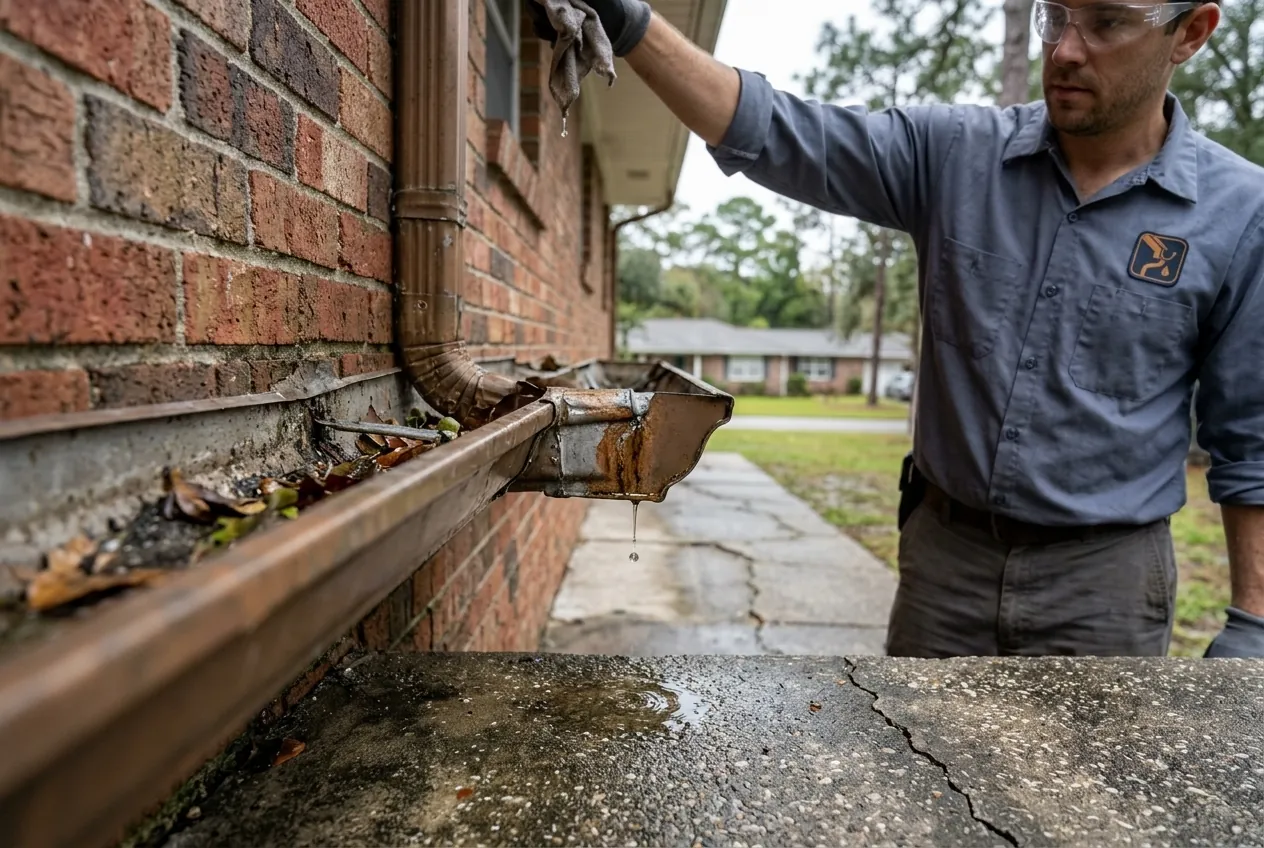
A seam is a lap joint held by rivets or a connector and kept watertight by sealant. Three things work against that sealant here.
- Heat cycling. A dark roof edge in a Gainesville summer gets hot in the afternoon and cools fast when a storm rolls through. Each cycle flexes the joint a little.
- Sun. Sealant exposed to strong UV dries, shrinks and cracks over time, starting at the edges of the bead.
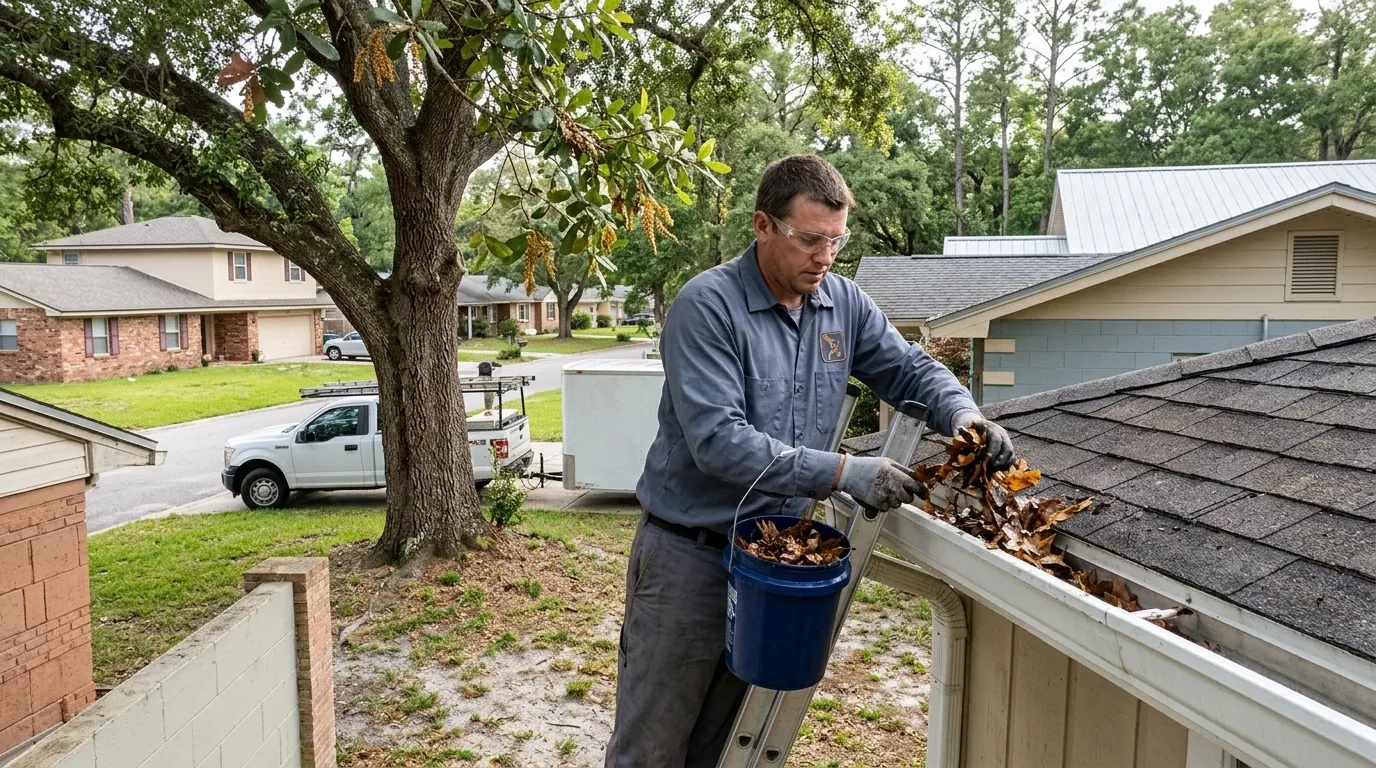
- Standing debris. Wet oak leaves and needles sitting on a seam keep it damp for days and hold tannins against it.
Once a seam opens, water drips at the same spot every storm, right onto the fascia, the siding or a walkway. Resealing helps for a while. Our gutter repair service handles that work, but when every seam on the house is going, replacement is usually the better spend.
Heat Expansion: The Real Limit of Seamless Gutters
Long seamless runs have their own issue. Aluminum grows and shrinks with temperature, at about 12.3 millionths of an inch per inch for each degree Fahrenheit according to standard engineering tables. That sounds tiny until you multiply it out. A 40-foot gutter is 480 inches long, so a 100-degree swing between a cold January dawn and a sun-baked July afternoon moves it about 0.59 inches.
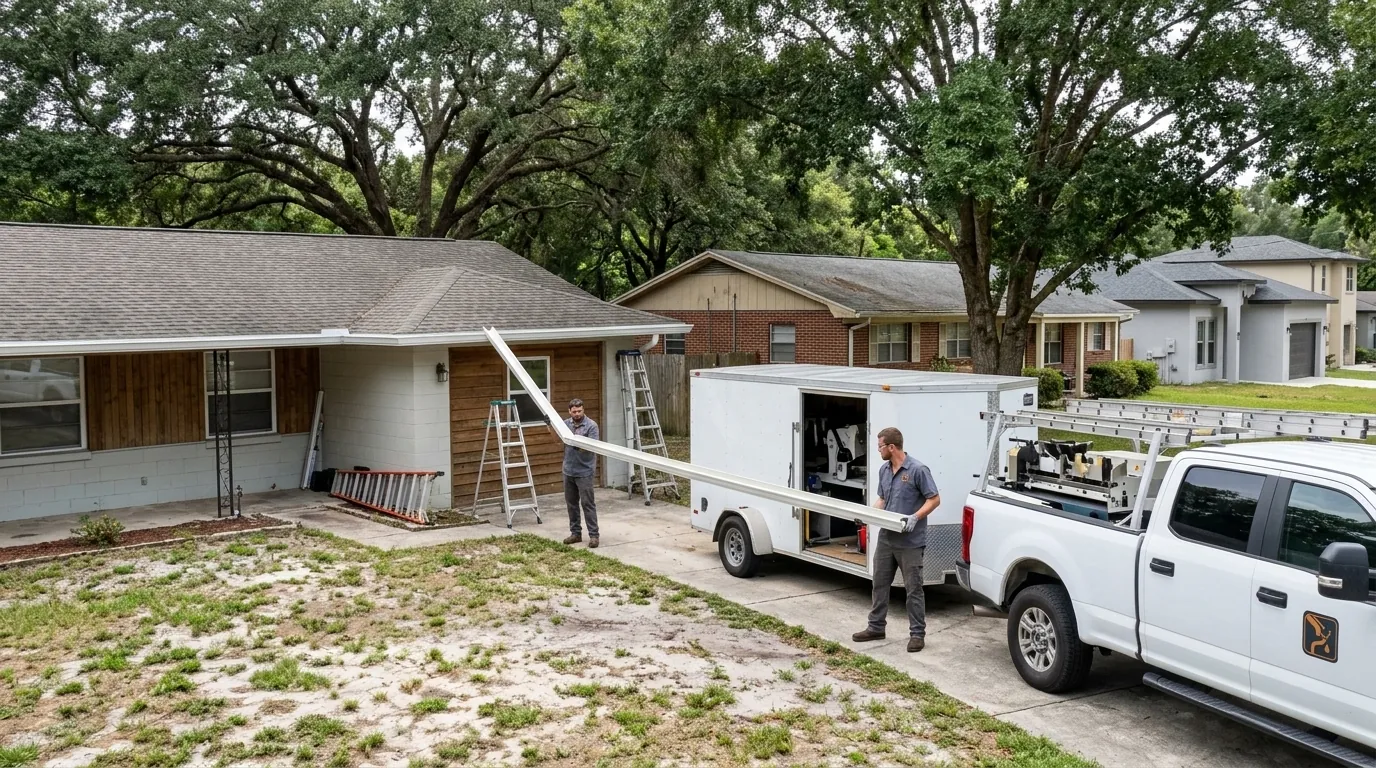
The fix is in how the gutter is hung. Hidden hangers clipped into the gutter and screwed into the fascia let it slide slightly as it moves. Old spike and ferrule setups pin the gutter hard, and over years of expansion the spikes work loose, which is why so many older gutters sag between spikes. On very long runs, an installer can add an expansion joint or split the run at a downspout so it moves in two shorter pieces.
Vinyl sectional gutters in Florida sun
Vinyl is the cheapest sectional option, and it has its own heat problem. Standard engineering tables list PVC as expanding more than twice as much per degree as aluminum, so vinyl runs move noticeably more between a cool morning and a hot afternoon. That movement is why vinyl systems rely on slip joints at every connector, and why those joints tend to open up and drip as the gaskets age. Years of strong ultraviolet light can also leave vinyl faded and more brittle, which shows up as cracks after a ladder bumps it or a limb lands on it. For a small run on a shed it is fine. For the main roof of a house, aluminum is the sturdier choice.
Seamless Gutter Thickness and Profile
Seamless aluminum coil for homes is commonly sold in thicknesses around .027 inch and .032 inch. Thicker metal resists ladder dents, holds its shape better between hangers and stands up to an oak limb tip resting on it. On two-story homes and anywhere ladders will lean against the gutter for cleaning, the heavier coil is worth asking about. Get the thickness written on your estimate.
K-style is the standard profile because its flat back sits tight to the fascia and its shape carries more water than a half-round of the same width. Half-round gutters suit some historic homes, and are usually installed in sections because the profile is harder to form on site.
When Sectional Gutters Still Make Sense
Seamless is our default for whole-house work, but sectional is not wrong in every case.
- Short runs and sheds. A 10-foot run over a back door or a shed has no middle joints either way.
- Matching an existing system. If one section is damaged and the rest is sound, a sectional piece in the same profile may be the cheapest repair.
- Historic half-round and copper. These are typically sectional by nature and joined by soldering or specialized fittings.
- DIY on a budget. Vinyl sectional kits are inexpensive and manageable for a handy owner on a single-story house, with the trade-off of more joints.
Seamless Gutter Details That Decide How Long They Last
Two seamless installs can look identical from the street and perform very differently five years later. The difference is in details most homeowners never see.
- Hanger spacing. Hidden hangers spaced closely, often about every two feet, keep a run straight under the weight of wet leaves. Wider spacing saves a few minutes and costs years of sag.
- Fasteners into solid wood. Hanger screws need sound fascia to bite. A screw into soft board holds for a season and then lets go.
- Miters at the corners. Corners are where seamless gutters still have joints, so they should be cut cleanly, riveted and sealed inside and out.
- Outlet placement. Downspout outlets belong at the low end of each section and below valleys, not wherever the ladder happened to be.
- Height under the roof edge. The back of the gutter should tuck under the drip edge so water off the shingles lands in the trough, not behind it.
- Color. Aluminum coil comes prefinished in many colors, so gutters can match the trim or fascia and never need painting.
These are the questions worth asking any installer, and the answers should show up in writing on the estimate.
Seamless Gutters in Gainesville Neighborhoods
Many homes built through the middle of the last century went up with sectional or galvanized gutters, and plenty still have them. In Kirkwood and Golfview, older houses with mature trees and more complicated rooflines are where we see the most failed seams. Newer subdivisions such as Haile Plantation mostly started with seamless, so the questions there are more about sizing, guards and HOA color approval.
Seamless Gutter Replacement: What to Expect
Switching from sectional to seamless is a gutter replacement job. A typical visit looks like this:
- Old gutters, spikes and hangers come down and are hauled away.
- Fascia is checked board by board, and rotted wood is replaced before anything is hung.
- Each run is measured, formed on site and lifted into place in one piece.
- Hidden hangers go in at close spacing, corners are mitered and sealed, and outlets are cut.
- Downspouts are hung and pointed where the water can drain away.
A standard one-story ranch usually takes a single day. Full installation pricing runs $1,200 to $2,800 for most one-story homes and $2,500 to $4,500 for most two-story homes. The breakdown is in how much gutters cost in Gainesville.
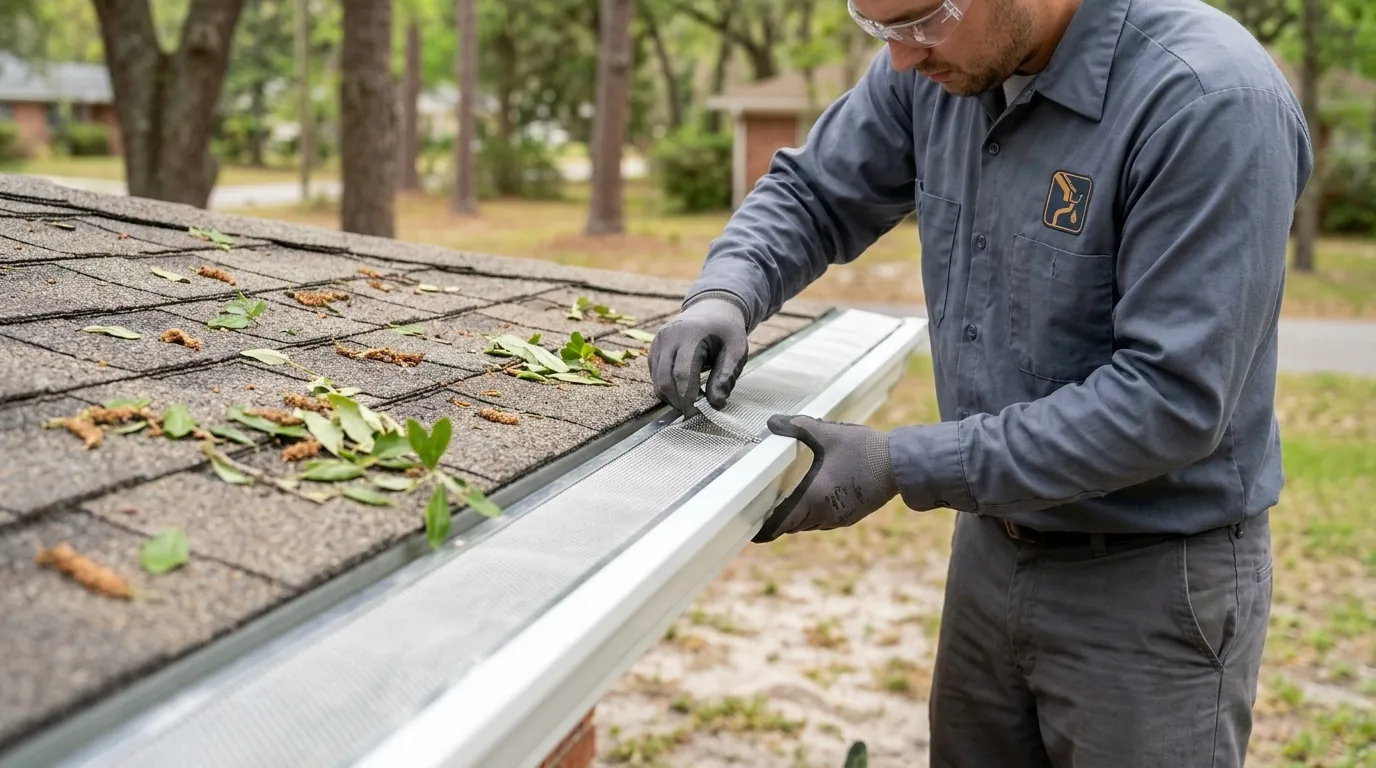
For a fixed written price on seamless gutter installation, request a free estimate. We measure every run and note the metal thickness, gutter size and downspout plan on the quote.