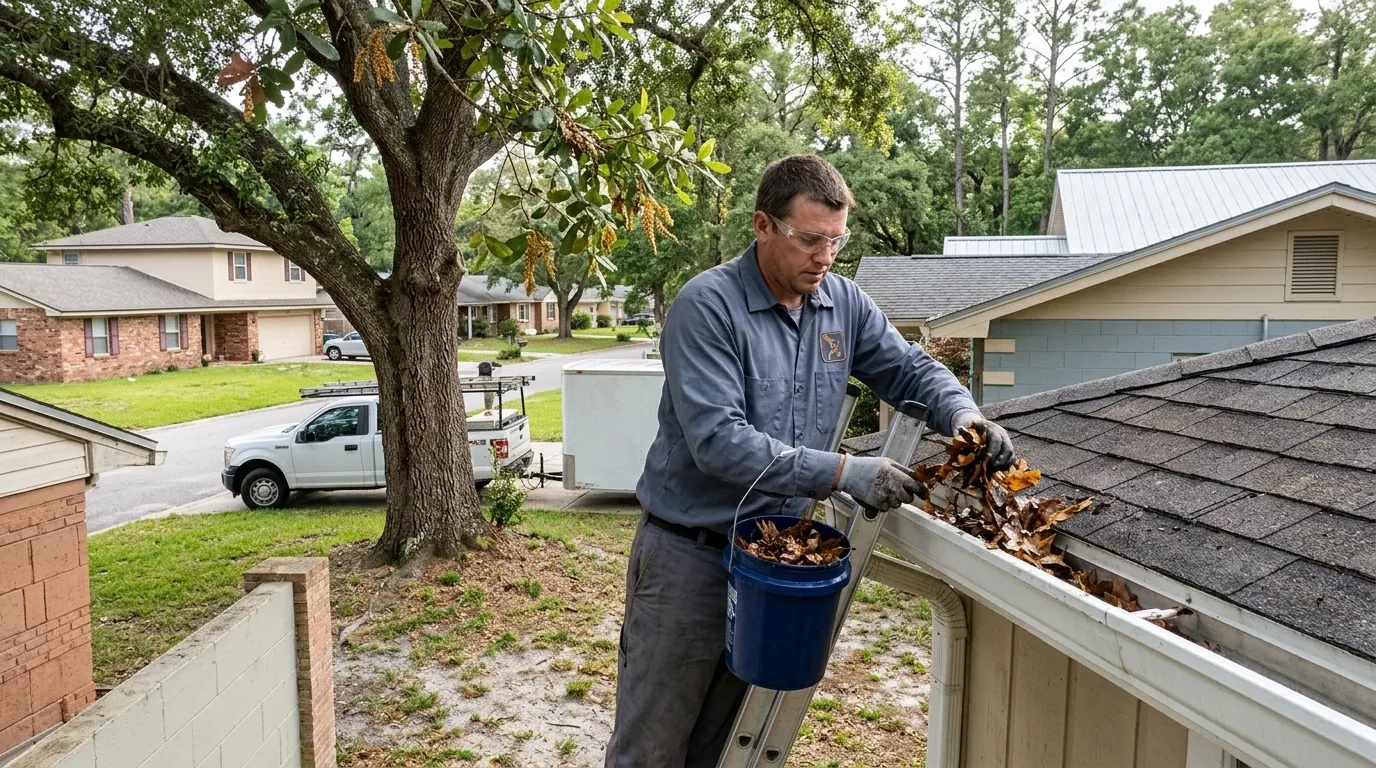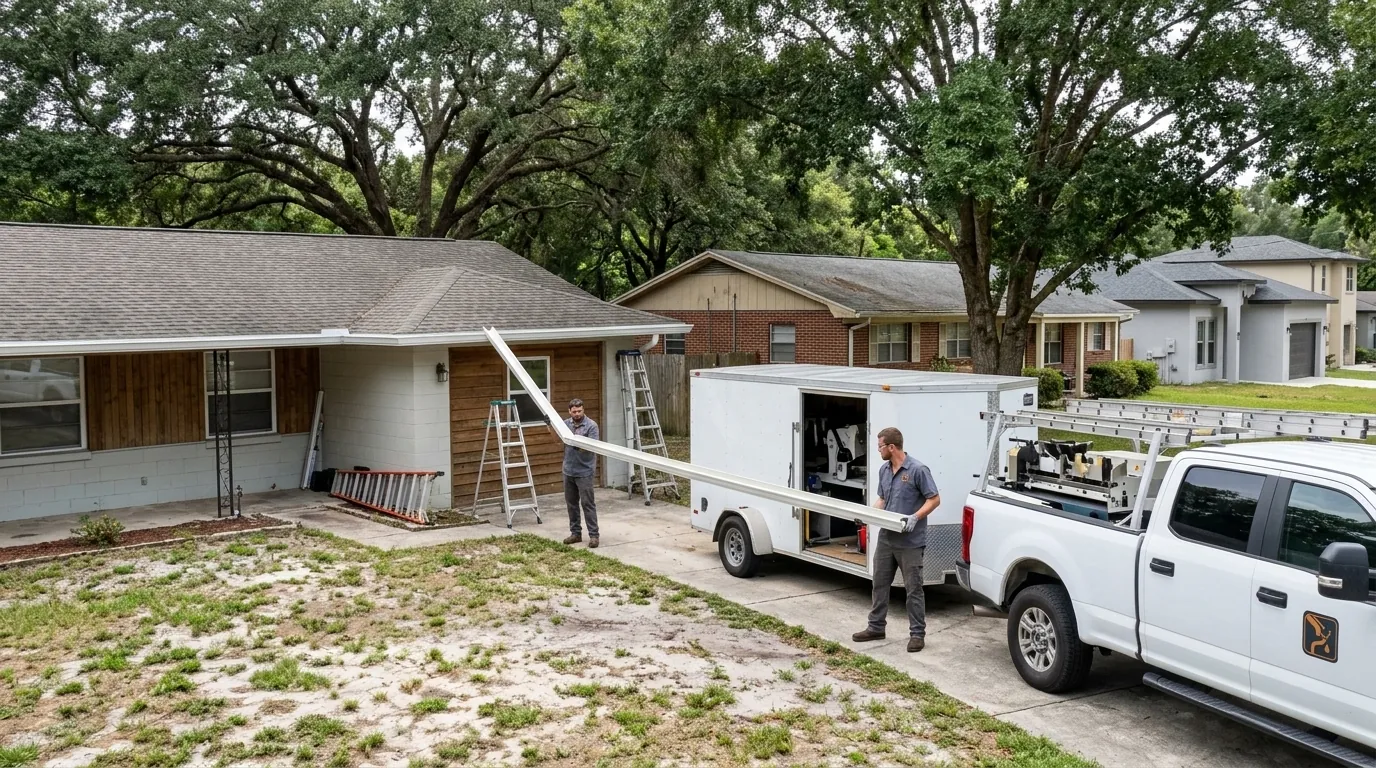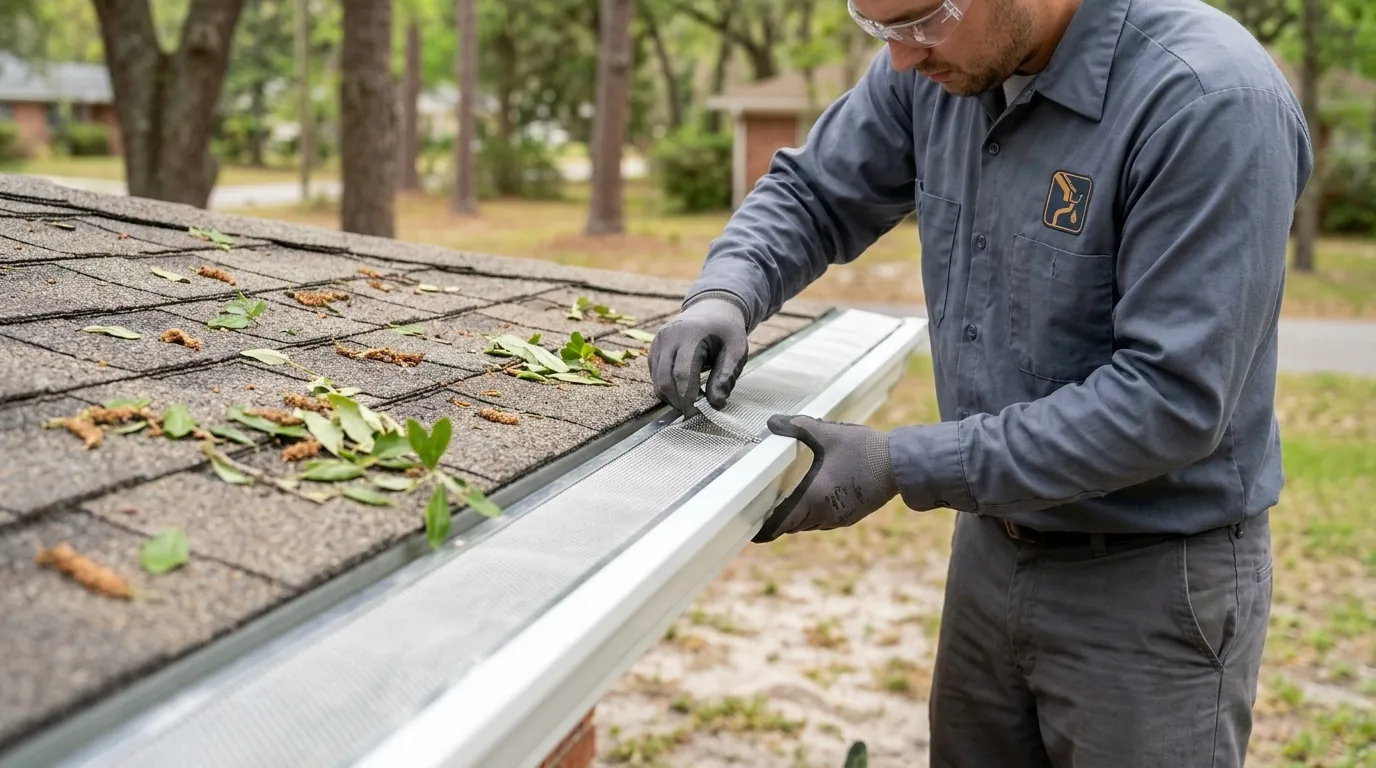
Most of the warning signs below can be spotted from the yard with no ladder at all, ideally during or right after a good rain. Some point to a simple fix. Others mean the gutter, or the wood behind it, is past saving. Knowing the difference saves money either way. This guide is written for homes around Gainesville, FL, where heavy summer rain, sandy soil and big trees all shape how gutters wear out.
Signs Your Gutters Need Replacing: The Ten to Check
| Sign | What it usually means | Repair or replace? |
|---|---|---|
| Sagging along the run | Failed hangers, rotted fascia or heavy debris | Repair if isolated, replace if widespread |
| Pulling away from the house | Spikes backed out or fascia too soft to hold | Fix the wood first, then rehang or replace |
| Drips at regular intervals | Sectional seams opening up | Replace if most seams leak |
| Water behind the gutter | Gutter set too low or missing drip edge flashing | Often a repair |
| Peeling paint or soft fascia | Water soaking the board | Fascia repair, often with new gutters |
| Overflow even when clean | Undersized gutter or too few downspouts | Upsize or add outlets |
| Standing water in a clean gutter | Wrong slope or sagging section | Rehang or replace |
| Cracks, splits or holes | Old metal, impact damage, rust on steel | Small ones repair, many replace |
| Mildew stripes or stains on siding | Water spilling over or leaking | Find the cause, then decide |
| Washouts or puddles at the foundation | Downspouts dumping too close | Drainage work, not always new gutters |
Sagging Gutters in Gainesville: Hangers, Weight and Wood
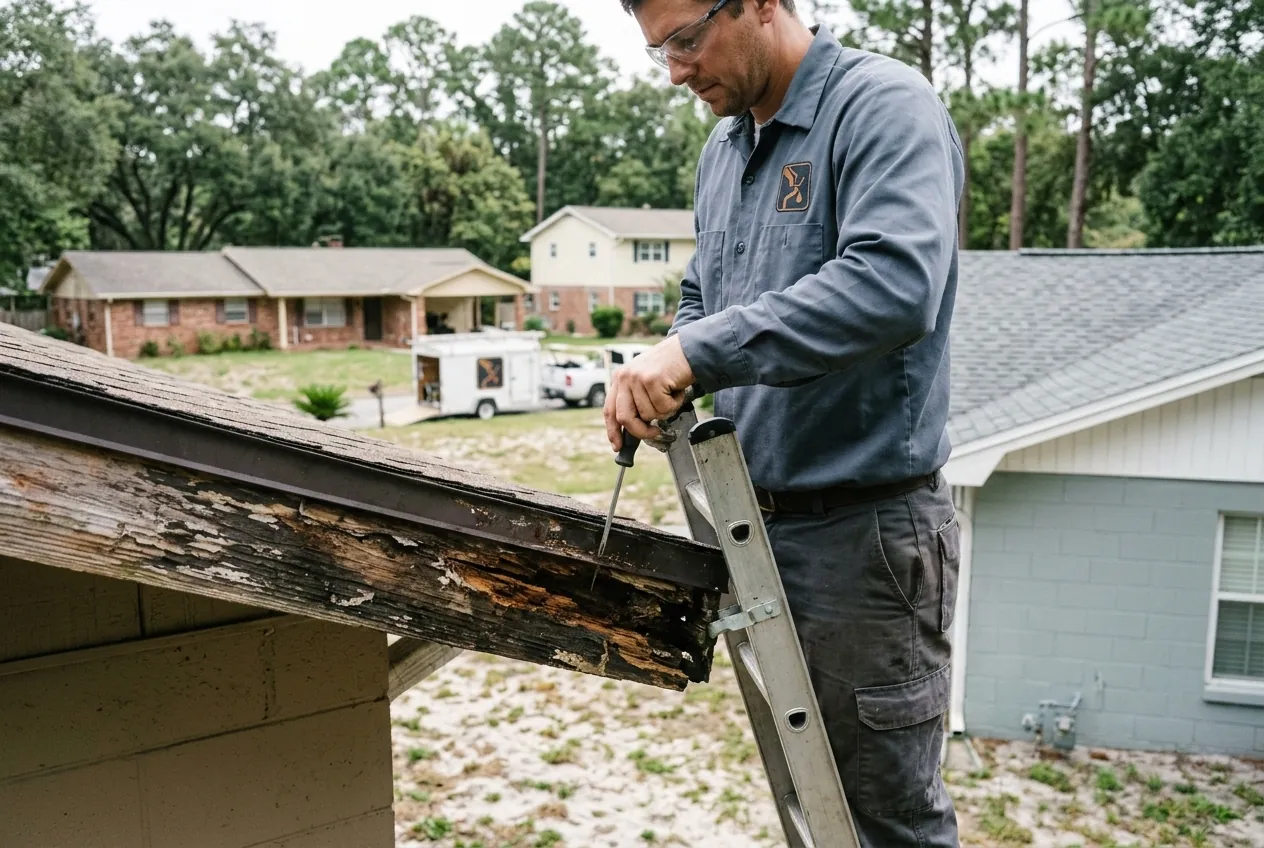
A full 5-inch gutter packed with wet oak leaves is heavy, and it hangs from a strip of wood that may have been taking on water for years. When a gutter sags, the cause is usually one of three things: old spike and ferrule fasteners working loose, hangers spaced too far apart, or the fascia itself giving way. Hangers can be added and spikes swapped for screws, but only if the wood behind them is sound. If a screwdriver sinks into the fascia, that has to be fixed first.
Leaking Gutter Seams and Corners
Drips at the same spots every few feet are the signature of a sectional system whose seams are failing. One or two leaks can be cleaned and resealed. When most of the seams on the house are dripping, resealing becomes a recurring chore, and replacing the system with one-piece runs is the lasting fix. We compare the two systems in seamless vs. sectional gutters.
Corners and end caps leak on seamless gutters too, but there are only a handful of them, and they are straightforward to reseal during a gutter repair visit.
Rust, corrosion and mixed metals
Older galvanized steel gutters rust from the inside out, usually starting where wet leaves sat in the bottom of the trough. Once you can see rust spots or pinholes from below, the steel is thin and patching rarely lasts. Aluminum does not rust, but it can corrode where it touches copper or bare steel, such as a copper flashing detail or a steel fastener in contact with the gutter. White powdery spots and pitting around those contact points are the clue. Using matching fasteners and keeping dissimilar metals apart prevents it on a new install.
Fascia Rot Behind Gutters: The Sign You Cannot See
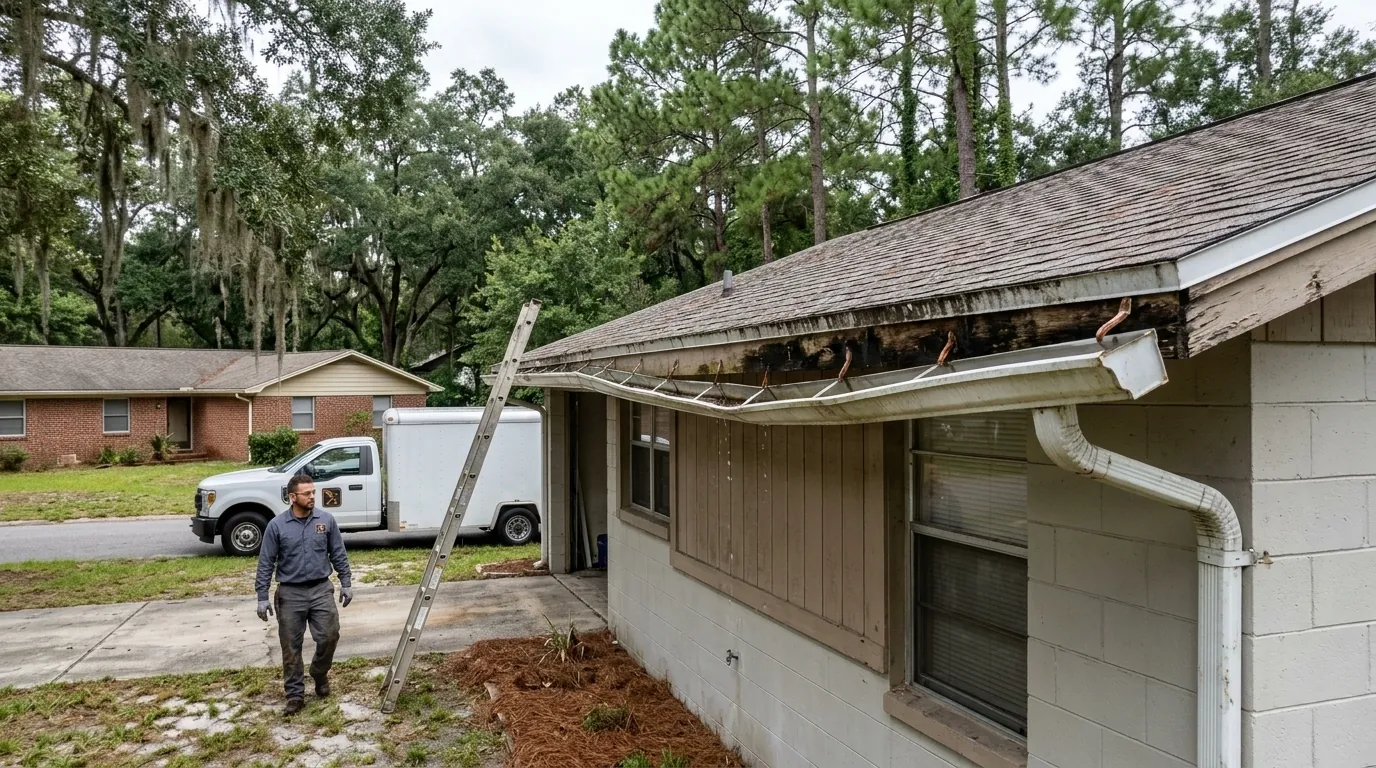
Fascia rot is the most expensive problem on this list, and the hardest to see, because the gutter hides most of the board. Wood decays when it stays wet. The USDA Forest Products Laboratory's guidance on wood decay ties serious rot to wood held near or above its fiber saturation point, roughly 30 percent moisture, which takes liquid water such as rain or leaks, not humid air alone. Dry wood, around 20 percent moisture or less, has a margin of safety. A clogged or leaking gutter that keeps the fascia wet through a Gainesville summer gives rot fungi exactly what they need.
Things to check from the ground and from a ladder:
- Paint peeling or bubbling on the fascia, especially near corners and downspouts.
- Dark staining on the board below the gutter.
- Soffit panels near the eaves that sag, stain or pull loose.
- Fascia that feels soft when pressed with a screwdriver tip.
- Gutter hangers or spikes that spin freely in their holes.
Rotted boards are replaced as part of fascia and soffit repair, ideally while the gutters are already down. Hanging new gutters on soft wood only guarantees they will sag again.
Overflowing Gutters in Florida Rain
If your gutters spill over the front in summer storms even right after a cleaning, the gutter is not the right size for the roof it serves. NOAA Atlas 14 puts Gainesville's 10-year, 5-minute rainfall rate at about 9.2 inches per hour, and a standard 5-inch gutter can only serve so much roof at that rate before it overflows. The fix may be one more downspout, larger 3x4 outlets or a move to 6-inch gutters on the worst runs. Our gutter sizing guide for Florida rain shows the math.
Washouts and Foundation Puddles
Gainesville's sandy soils move easily. A downspout that dumps right at the corner of the house can carve a trench, undermine a walkway or leave water standing against the slab edge after every storm. This is not always a gutter problem. Often the gutters are fine and the outlets simply need extensions or a buried line. Our downspouts and drainage service handles that work on its own.
Gutter Damage After a Gainesville Storm
Summer thunderstorms and tropical systems add their own wear. After a big blow, walk around the house and look for these:
- Dents or kinks where a falling limb or pine cone cluster struck the gutter.
- Sections twisted or pushed back toward the roof by wind or a branch.
- Downspouts knocked loose at the elbows or straps.
- Gutters packed with leaves and twigs so they sit lower than before.
A single dented section can often be replaced on its own. If a limb has crushed a long run or torn hangers out of the fascia, the wood needs a look before anything is rehung. Take dated photos of the damage before cleanup if you plan to talk to your insurer, then clear the gutters so the next storm does not do more harm to the fascia behind them.
Gutter Repair vs. Gutter Replacement in Gainesville
Here is a simple way to decide.
- Count the problem spots. One or two leaks or a single sagging section are repairs, usually $125 to $600.
- Check the wood. If the fascia is sound, repairs hold. If long stretches are soft, the gutters have to come down anyway.
- Look at the system type. Old sectional or galvanized steel gutters with failing seams everywhere rarely justify more repair money.
- Think about size. If the gutters overflow even when clean, repairing them keeps an undersized system in place.
- Compare costs. If repairs would run more than a third or so of the price of new gutters, replacement is usually the better value.
Full gutter replacement for most one-story homes runs $1,200 to $2,800, and $2,500 to $4,500 for most two-story homes. Fascia work is priced separately at $300 to $1,500 depending on how much is rotted. More detail is in our Gainesville gutter cost guide.
Where Gainesville Gutters Wear Out First
Age, trees and roof shape all play a part. In Northwood, ranch homes from decades past often still carry their original sectional gutters, and spike fasteners and tired seams are common findings. In Oakmont and other newer communities, gutters are younger, so problems tend to be specific: a valley that overshoots, a downspout that dumps on a walkway, or a run that was never sized for the roof above it.
Wondering if yours can be saved? Request a free estimate. We will check the gutters, hangers and fascia, and tell you honestly whether a repair will hold or replacement makes more sense, with a fixed written price for either.