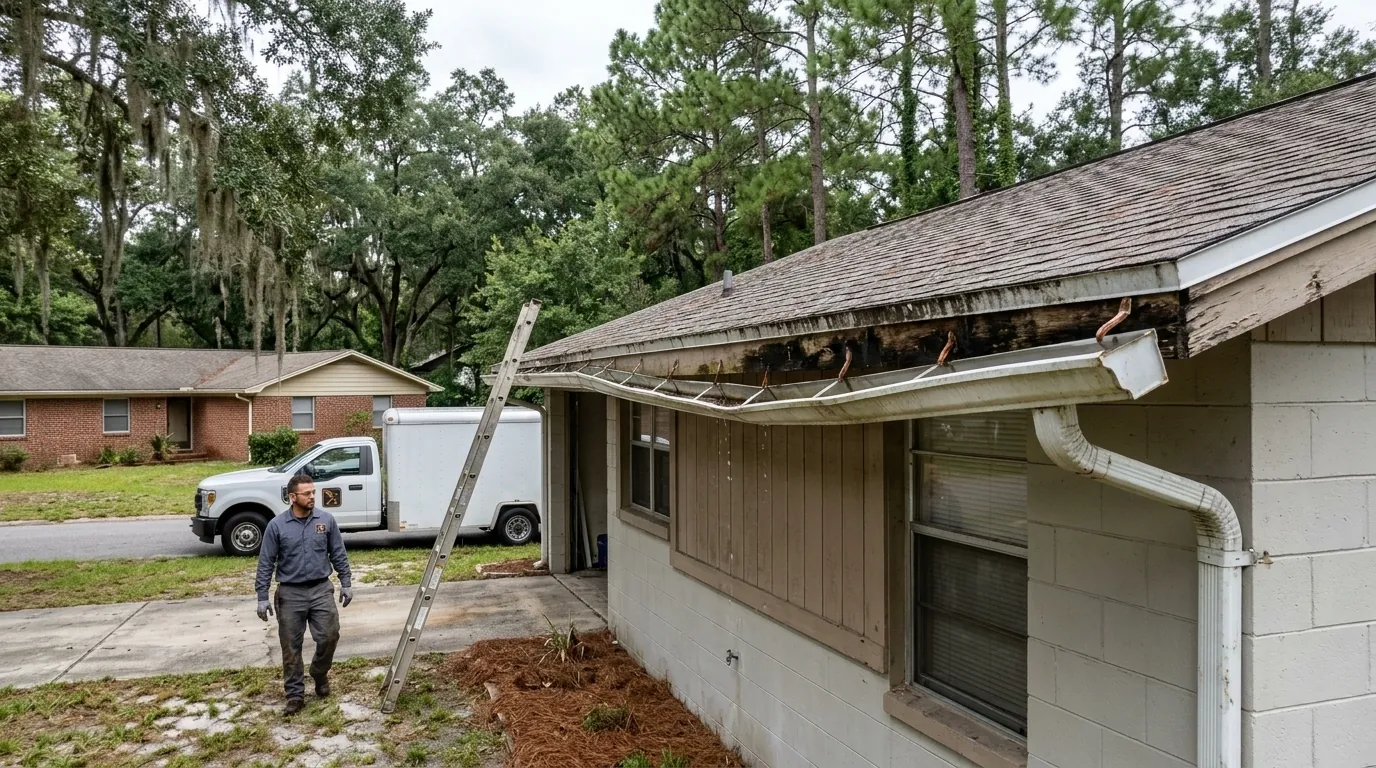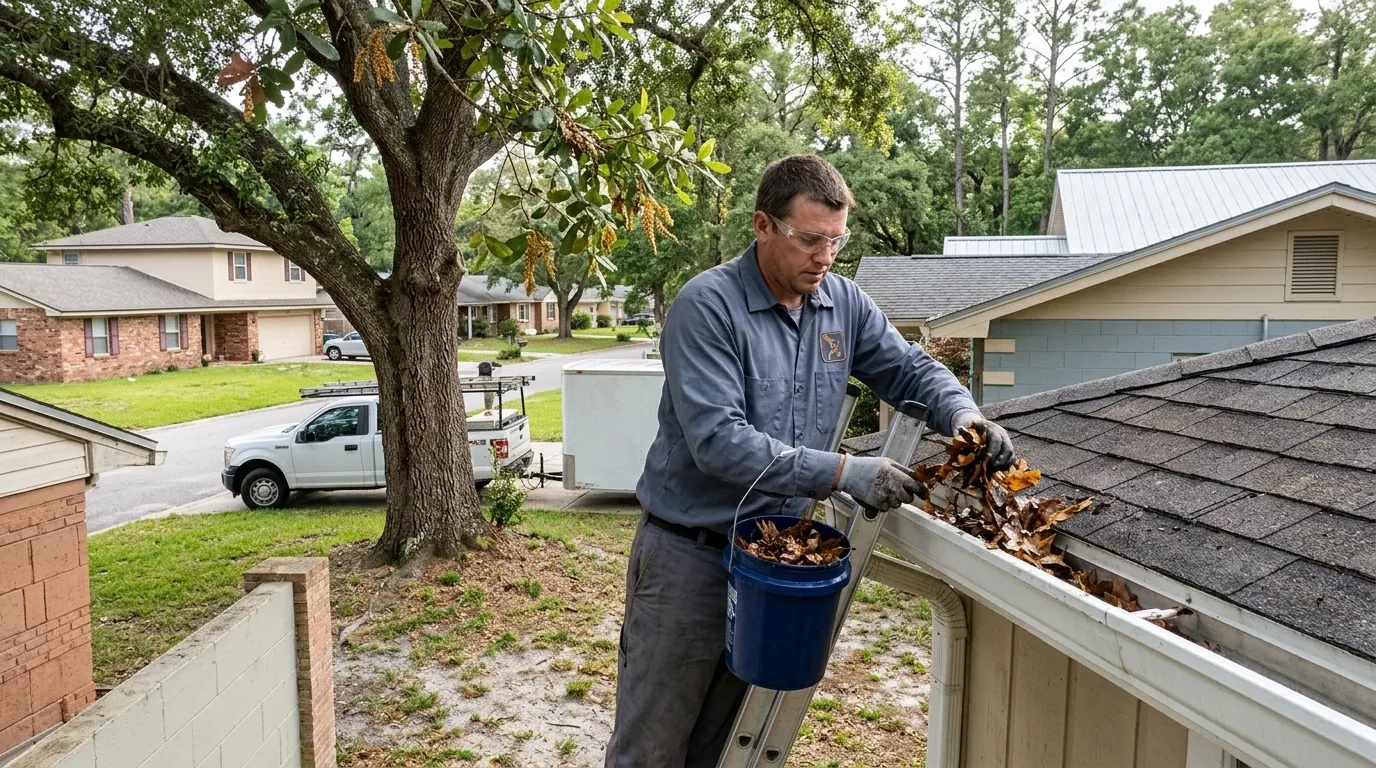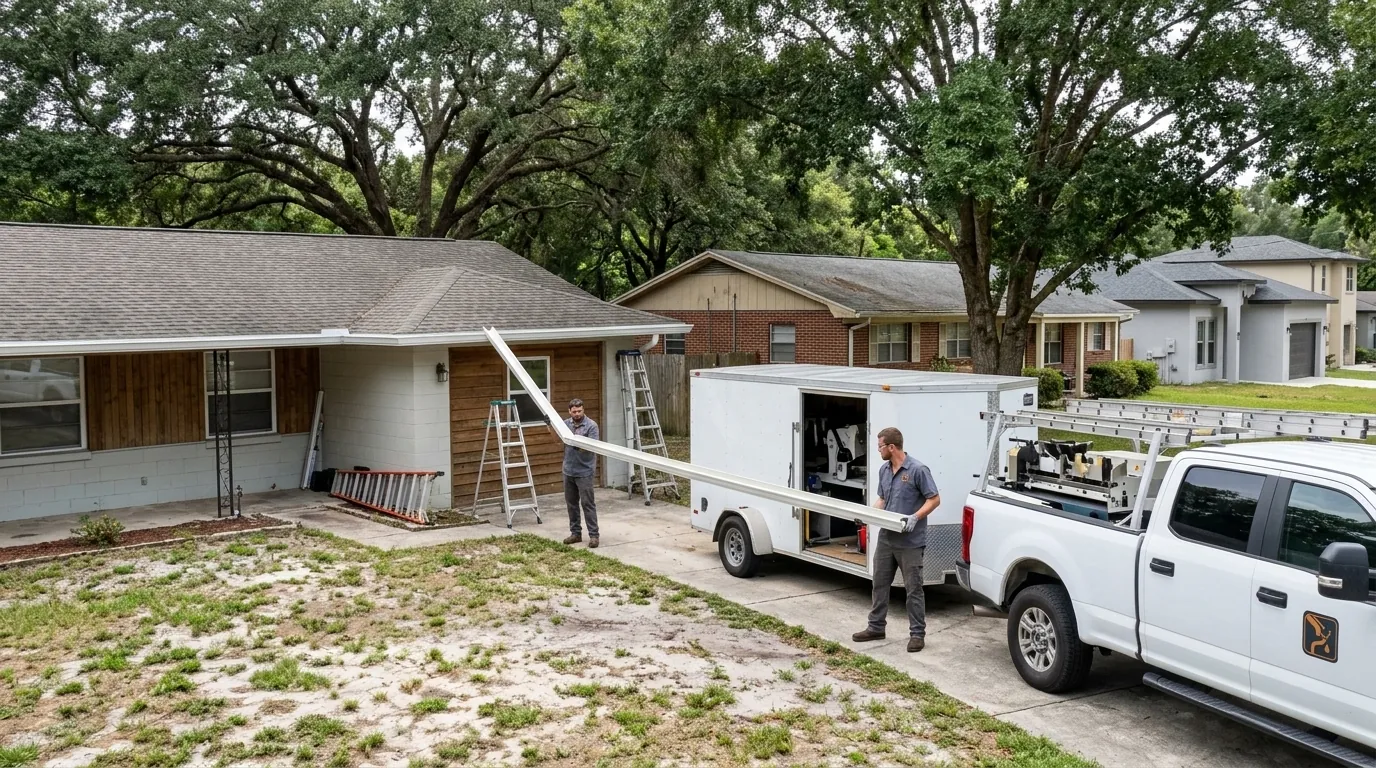
Gutter guard ads promise you will never clean a gutter again. Under a mixed oak and pine canopy, that is not quite true for any product. What a good guard does is turn a messy, clogging job on a ladder into a quick brush-off, and keep the downspouts clear between visits. The right choice depends on what falls on your roof. For most homes in Gainesville, FL, that means oaks and pines together.
Gutter Guards for Oak Trees: What Oaks Actually Drop
Oaks shed on a schedule that surprises people from up north. Live oaks are semi-evergreen. They drop most of their old leaves in late winter and early spring as the new leaves push out, and an FSU facilities report on its campus trees notes that the drop typically wraps up around the end of March. At the same time, oaks flower and drop long strands of male catkins, the brown "tassels" that pile up on cars and roofs.
- Live oak leaves are small, stiff and waxy. They slide easily on a roof but pack tightly in a trough.
- Laurel and water oak leaves are larger and thinner, and they mat down when wet.
- Catkins are fine and stringy. They wrap around screen wires and weave into a mat with leaves and pollen.
- Acorns arrive in fall, roll into downspout elbows and jam them.
Gutter Guards for Pine Needles: Why Needles Are Different
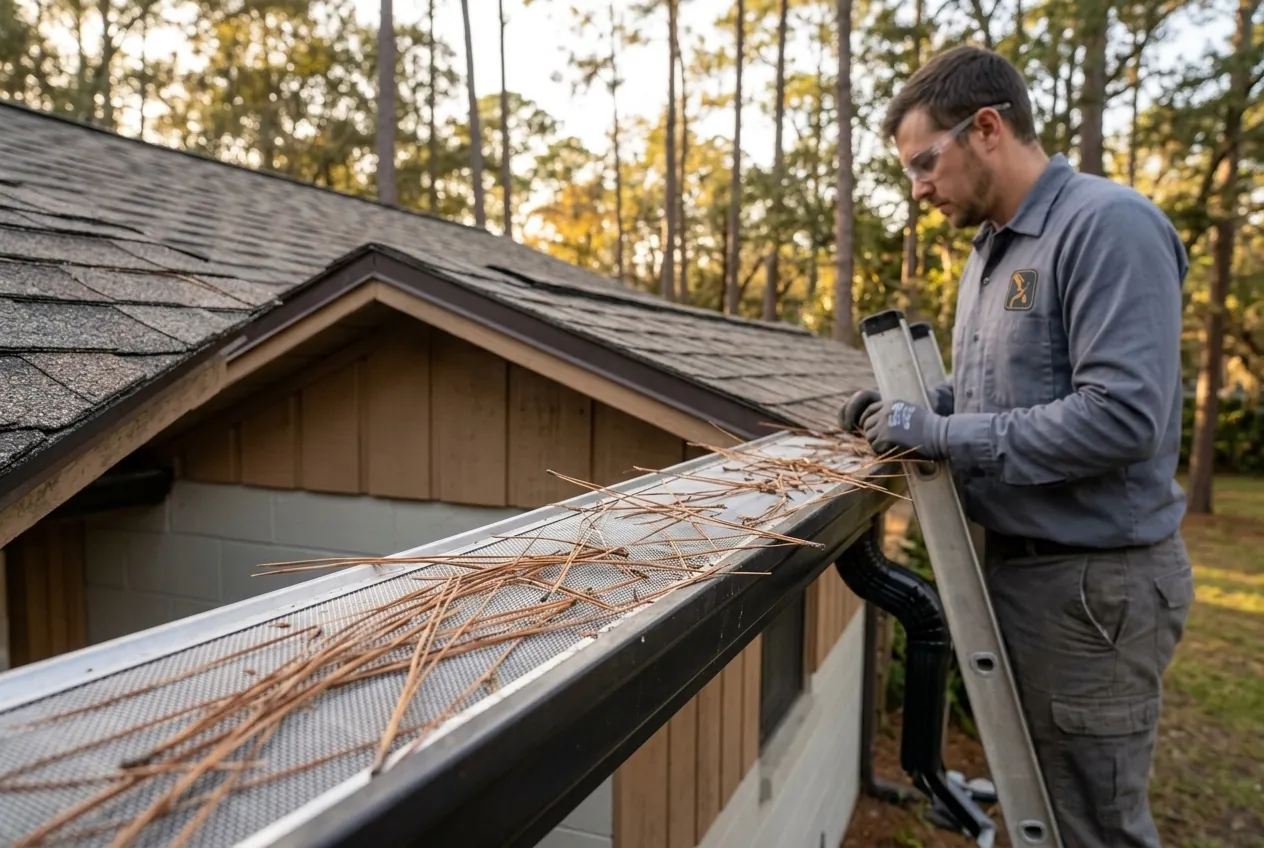
Pines shed their oldest needles in fall. A UF/IFAS Extension article from neighboring Marion County describes this browning and drop as normal for Florida pines, more noticeable after a dry stretch. Loblolly, slash and longleaf needles are long and thin, often several inches or more, and they behave nothing like leaves. They slip through wide openings point first, bridge across screens, and stand up like straws in a trough where they catch everything else.
Gutter Guard Types Compared for Gainesville Debris
Here is how the main guard designs handle the two debris types, based on how each one is built.
| Guard type | Oak leaves & tassels | Pine needles | Main weakness |
|---|---|---|---|
| Micro-mesh (fine stainless mesh on a rigid frame) | Good. Leaves sit on top and dry, then blow off. | Good. Openings are too small for needles to enter. | Pollen and tannin film can slow water; needs a rinse |
| Perforated aluminum or vinyl screen | Fair. Leaves stay out, tassels lodge in holes. | Poor. Needles slip into holes and stick. | Clogs at the openings, hard to clean |
| Reverse curve (surface tension hood) | Fair to good on big leaves | Fair. Needles can follow water in. | Can overshoot in heavy rain; visible from street |
| Foam insert | Poor. Leaves rot on top, seeds sprout. | Poor. Needles stab in and stay. | Holds moisture, breaks down in sun |
| Brush insert | Poor. Leaves tangle in bristles. | Poor. Needles weave into the brush. | Must be pulled out to clean |
For mixed oak and pine canopy, micro-mesh is the only type we install as a standard recommendation. Screens and inserts are cheap, which is why they show up on so many houses, but they tend to trade one cleaning problem for a harder one.
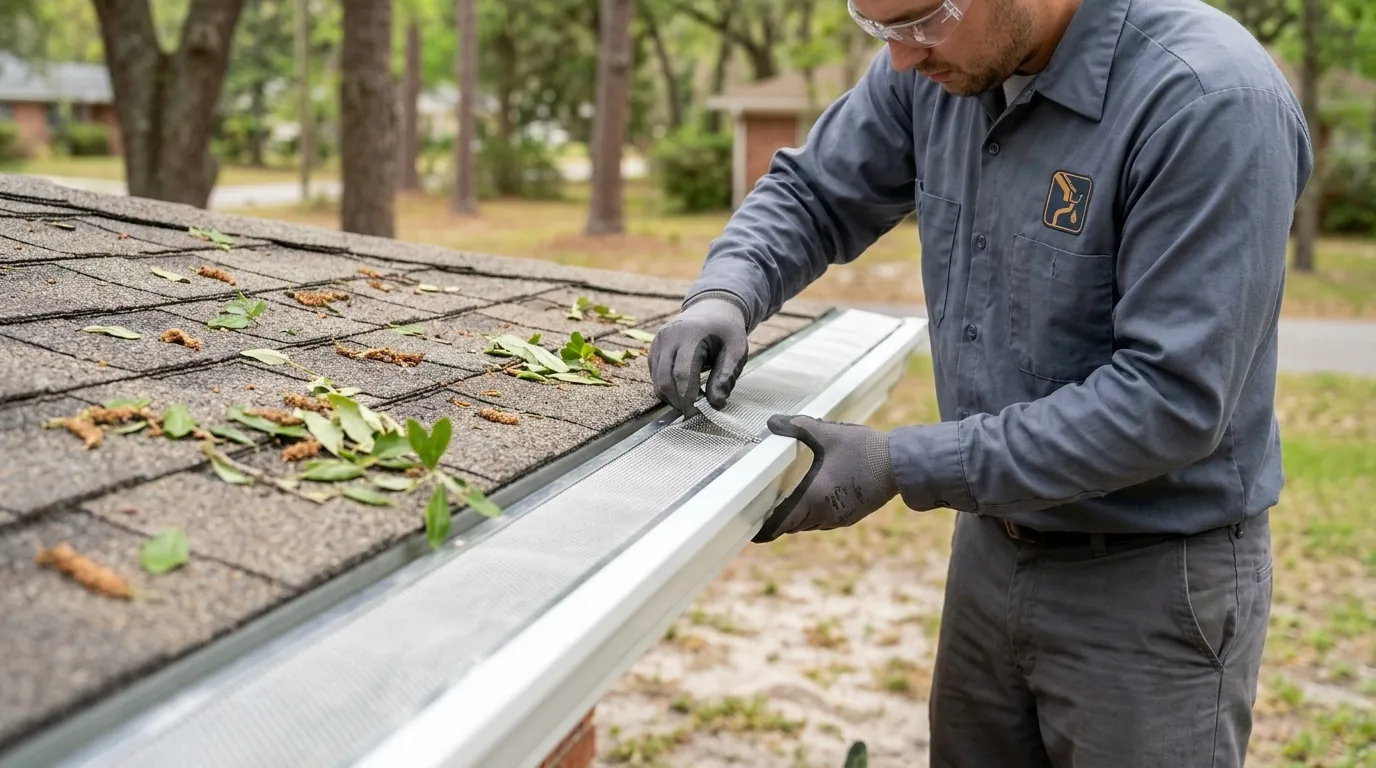
Micro-Mesh Gutter Guards in Gainesville: The Honest Caveats
Micro-mesh is the best option here, not a perfect one. Three things to know before you buy:
- Spring film. Oak pollen, catkin fragments and the tannins washed out of wet leaves can leave a fine film on the mesh. Water still goes through, but more slowly. A soft brush or a hose once or twice a year restores it.
- Needles lying flat. Under heavy pine, needles can collect on top of the mesh along a flat run. They cannot get into the gutter, but they can shed water over the edge until they blow off or get brushed away.
- Peak rainfall. NOAA puts Gainesville's 10-year, 5-minute rainfall rate at about 9.2 inches per hour. In bursts like that, some water can skate across any guard, especially at valleys. A valley splash guard and a correctly sized gutter underneath matter as much as the mesh. Our post on what size gutters handle Florida rain covers the sizing side.
How We Install Gutter Guards on Gainesville Roofs
A guard is only as good as its fit. On our gutter guard jobs, a typical install looks like this:
- The gutters are cleaned and flushed first, and downspouts are cleared to the ground. Putting guards over a clogged system just hides the clog.
- Loose hangers and leaking seams are fixed before anything covers them. If the gutter itself is in bad shape, we will tell you, because a guard on a failing gutter is wasted money.
- The guard mounts to the front lip of the gutter and sits at the back along the roof edge without lifting or nailing through shingles where the roof edge allows it.
- Corners and valleys get trimmed pieces and splash guards so heavy flow does not shoot past.
Guards sit on top of the gutter, so the condition underneath still matters. If you are replacing old sectional gutters anyway, doing seamless gutter installation and guards in one visit avoids a second setup.
Gutter Guard Cost in Gainesville vs. Cleaning
Installed micro-mesh typically runs $6 to $15 per linear foot. On a one-story house with 150 feet of gutter that is $900 to $2,250. Compare that to two or three cleanings a year at $95 to $175 each, or $150 to $275 for two-story homes. Our Gainesville gutter cost guide runs the break-even math in more detail.
| Option | Typical cost | Ongoing upkeep |
|---|---|---|
| Micro-mesh guards | $6 to $15 per ft installed | Rinse or brush the mesh once or twice a year |
| Cheap screens or inserts | Low upfront | Frequent clogs, often removed later |
| No guards, regular cleaning | $95 to $275 per visit | Two to four cleanings a year under heavy canopy |
Which Gainesville Homes Benefit Most From Gutter Guards
Guards pay off fastest on homes where cleaning is frequent, difficult or risky.
- Wooded lots in Millhopper where tall pines and oaks stand right over the roof.
- Older in-town streets like Golfview, where mature trees have had decades to grow out over the eaves.
- Two-story homes, where every cleaning means tall ladders and steep roof edges.
- Houses with screen enclosures, where an overflowing gutter dumps leaves and water straight onto the pool cage roof.
Gutter Guard Maintenance Under Gainesville Oaks and Pines
A micro-mesh system needs a few minutes of attention a couple of times a year. Timing those visits to the tree calendar keeps the mesh flowing at full speed when the summer storms arrive.
- April or May. After the live oak drop and the tassels are done, brush or hose the mesh surface to clear pollen film and any matted catkins. This is the most important visit of the year.
- Midsummer, after big storms. Look from the ground for leaves or small twigs piled at valleys and inside corners, where flow is heaviest.
- December. Once the pines have finished shedding, sweep off needles lying on flat runs and check that the downspout outlets are clear.
- Any time. If water sheets over the front of a guarded gutter in a moderate rain, the mesh needs cleaning or the gutter below has a clog at the outlet.
Never pressure wash a mesh guard from close range. A garden hose and a soft brush on a pole do the job without bending the mesh or forcing debris into the gutter.
If your home only has one or two trees nearby and they are not overhanging the roof, regular gutter cleaning may be cheaper than guards for many years. We will tell you that during the estimate rather than sell you something you do not need.
To see what a micro-mesh install would cost on your house, book a free estimate. We will measure every run, check the gutters underneath and price it in writing.